
Foundational Books
And Book Banning

I had a post ready to chat about epic, new science fiction along with a digest of lists and blogs highlighting top reads in the category. It was all in honor of The Ring Academy: The Trials of Imogene Sol. Then I caught the news of what is happening in Mississippi with public access to eBooks and audiobooks (source material listed below) in which a law has been passed to ban both from being accessed by anyone under 18. Add that to what’s been happening in Florida and other states across the country regarding book bans and limiting access to books, and I needed to process it.
So here’s a story…
By the time I was nine, a third grader at Ferguson Elementary School, I had learned that my school library and disappearing into books were places of refuge. As an introvert who needed quiet and solitude to refill the well, I took any opportunity I had to decompress, and my library was where I went to find it.
It was a beautiful room. To my nine-year-old eyes, gigantic and expansive, though now as an adult even if I recall that space being a giant room, I logically know it was probably no bigger than a classroom or two. There were stacks upon stacks of books, carpets for sitting, a desk where the librarian would check out your books, tables and chairs, blue walls on which colorful posters were hung, bright windows that allowed in sunlight. I was in love with the place.
By the time I was in 3rd grade, I’d read every Beverly Cleary book I could get my hands on: Beezus and Ramona; Ramona, the Pest; Ralph S. Mouse; Ramona Quimby, Age 8; Henry Higgins; Dear Mr. Henderson. I was hungry for something new. I don’t remember the exact circumstances, but the librarian said, “I have just the book for you,” and led me away from the section I was used to borrowing books into the unknown—the older section of the library where the bigger kids went. The librarian pulled a hardcover blue book from the shelf.
“This one is an adventure. In space.” She smiled and held it out to me.
The title was But We Are Not of Earth by Jean E. Karl, and it was a brand new book (published in March of 1984). Underneath that shiny library cover, the book’s blue cover was a swirl of washed out, watercolor images of a girl set against a backdrop of planets and spaceships looking anxious and afraid. Inset, just under her was a group of people. I don’t remember being instantly taken with the cover, but I was intrigued.
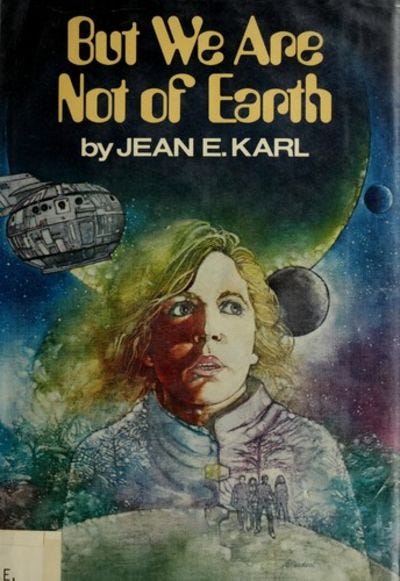
“It’s about these students in a space school.”
It wasn’t my normal fare, but the librarian’s enthusiasm was infectious, so I checked it out and read it. Then reread it and absolutely loved it. It became an all-time favorite so much so that I’m writing about it to you forty years later. The premise was about a group of students—ready to demonstrate what they’d learned for the year—had to man a spacecraft and visit three uncharted planets to determine if any were habitable. Working as a team—with one adult mentor should anything go wrong—each student was responsible for their “role” on the craft: pilot, environment, security, communication, health. Well, of course, something goes wrong. The ship is sabotaged and the kids have to land on an uncharted planet. The students not only have to keep themselves alive but also solve a mystery of who sabotaged their ship.
Karl’s story stuck with me so much so that forty years later I can still remember it. I suppose it isn’t a surprise I’ve written The Ring Academy: The Trials of Imogene Sol. While the premise is different—a young woman trying to stay alive and clear her name while facing the final trials of her school program—a school in a distant future set in space isn’t.
What does this story have to do with banning books?
Stick with me.
There are formative books in our lives. Stories we read, are told, see, or experience that are integral to the substance of who we are. Foundational. These stories shape our thinking and help us determine what we believe. They are books that challenge our notions and teach us something new. They are books that offer us awareness beyond the boundaries of our current understanding so that we can empathize with someone else. While But We Are Not of Earth wasn’t one of those books that challenged my perceptions as a nine-year-old, it did light a reading fire, and that reading fire has made sure I became a life-long reader who has continued to read and pushed herself to read books that pushed my boundaries to challenge my preconceived notions, to open my lens wider so I can see clearer.
Book banning is another way to control culture just as what is published (in any form of media) is about shaping it. When you look at the lists of banned books, the books selected are always books that challenge the parameters of normalized, white, patriarchal structures. These bans, more often than not, seek to silence authors who are pressing those cultural buttons to provide new understanding, challenge preconceived notions, and inform. Additionally, those banned books are most often written by marginalized voices (authors of color, radicals, LGBTQ+).
Ask yourself: Why?
Morality? While this is often cited as the reason it can’t be the answer. Not in a nation that separated church and state. The legal precedent (Everson v. The Board of Education, 1947) upheld the First Amendment of our US Constitution stating that government cannot promote religion but it can’t obstruct it. If there are people calling for bans based on religion foundation, fine. That is within their rights as US citizens, but to use the government to do it is against the US Constitution. The Mississippi Law on the surface may seem reasonable, but what is the foundation? Morality? Maybe it’s ethics? Anyone under 18 is denied access eBooks or Audiobooks, but then wait, who suffers? What kids are attempting to access audiobooks and eBooks through their public libraries? This is a dig at not only free thinking but economic ACCESS, and hurts those of lower SES who need the library to access books. Let me get this straight, Mississippi, a kid who’s under 18 can’t check out an eBook, but a girl can be legally married off by her parents at 15? How is any of that ethical (or moral).
These book banning laws absolutely malign the First Amendment of our Constitution.
Tell me, how is banning books or restricting access any different than what Nazi Germany did beginning in 1933 when they burned books that were labeled “unGerman”. I’d like to point out with a shudder that Ray Bradbury’s Fahrenheit 451 (and a banned book my friends) was published in 1953. If you haven’t read it for a while—reread it. It’s sobering.
Tracie D. Hal, Time person of the year and librarian said, “Free People read freely.” How on earth can we claim to be a free and democratic society when access to material that enhances our critical thought and awareness is limited. Benjamin Franklin said, “Without freedom of thought, there can be no such thing as wisdom; and no such thing as public liberty without freedom of speech.”
Pen.org:
BBC.org:
https://www.bbc.com/culture/article/20230525-how-book-banning-escalated-in-the-us
NewYorkTime.org
https://www.nytimes.com/2022/01/30/books/book-ban-us-schools.html
Washington Post
PBS.org
https://www.pbs.org/newshour/arts/mississippi-mayor-withholds-library-funds-over-lgbtq-books
TheMarySue.Com
Findlaw.com
Holocaust Encyclopedia
https://encyclopedia.ushmm.org/content/en/article/book-burning